
DECODING SINATRA’S VOICE : MARK TREMONTI
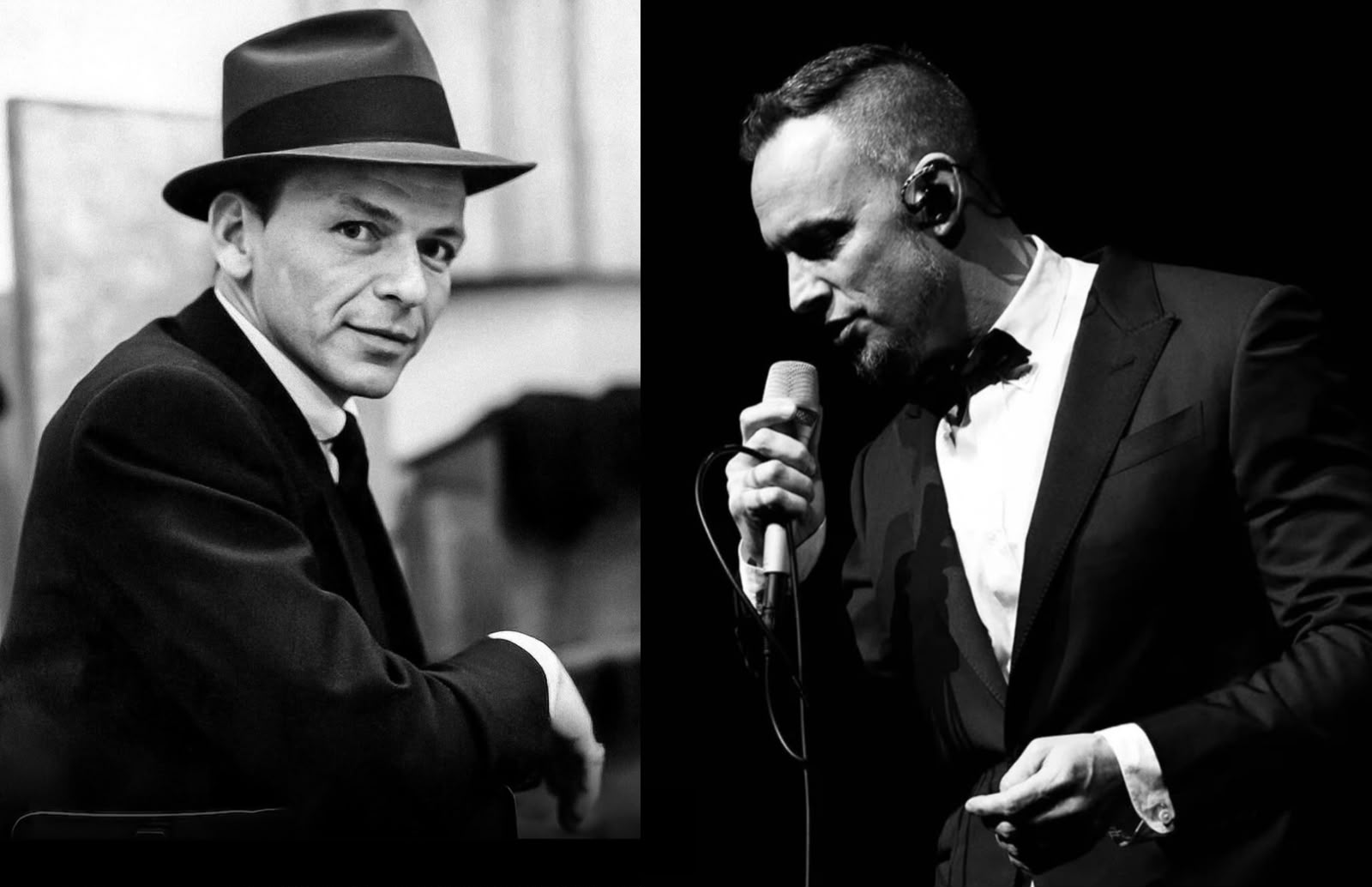
Decoding Sinatra’s Voice: Mark Tremonti
How did a metal guitarist dissect Frank Sinatra’s pronunciation, breath control, vibrato, and timing—and reconstruct them in his own voice?
At first glance, Mark Tremonti’s decision to explore Frank Sinatra’s repertoire might seem like an unexpected musical choice. After all, Tremonti is best known as the guitarist of Creed and Alter Bridge. The very idea of a musician from the world of distorted guitars and heavy riffs performing songs made famous by one of the greatest interpreters of American popular music is intriguing in itself. But what surprised me most was just how closely Tremonti managed to approach Sinatra’s distinctive style.
One day, when a friend whose musical ear I trust immensely came over, I played Tremonti’s rendition of “I’ve Got You Under My Skin”. Almost immediately, he exclaimed, “Sinatra!”
“No, it isn’t. Listen again,” I replied.
“What do you mean? That’s Sinatra!” he insisted, astonished.
His mistake was hardly surprising. What we hear in Tremonti’s performance is not simply a baritone voice resembling Sinatra’s, but a meticulous reconstruction of many of the details that define Sinatra’s musical identity, carried out with an engineer’s precision.
To my ears, the secret of this remarkable album lies in the fact that Tremonti did not merely listen to Sinatra and imitate him. He effectively decoded Sinatra’s voice, mapping out something resembling his musical genetic blueprint.

A Guitarist’s Vocal Laboratory
Mark Tremonti’s approach resembles the way one guitarist might analyze another guitarist’s technique. Learning a guitar solo involves much more than playing the correct notes. The speed of a bend, the width of the vibrato, the way notes connect, and their timing all contribute to a performance’s distinctive identity.
This reminds me of a wonderful observation by my dear friend and guitar master Gökhan Pislickkedi about legendary guitarists such as Eddie Van Halen, Jimi Hendrix, and Jeff Beck, who can be recognized from the very first note they play. Every guitar virtuoso has a unique, unmistakable musical signature—one that reveals itself almost instantly.

Tremonti adopted a similar approach when studying Sinatra’s voice, drawing on his identity as a guitarist. In interviews given in 2022, he described rewriting Sinatra’s song lyrics on his computer. But these were not lyrics written in standard English. They were personal phonetic transcriptions designed to capture the words exactly as Sinatra pronounced them.
Whenever Sinatra modified a vowel sound, Tremonti recorded it. When Sinatra connected words, he marked the connection. When he extended a particular syllable, Tremonti made a separate note. He also attempted to transcribe not only pronunciation but timing. If a word fell slightly ahead of or behind the beat, he adjusted its position on the page, using arrows and various symbols to make the movement of a musical phrase visible.
Much like choreology, in which dance movements are recorded through a specialized system of notation, Tremonti developed his own markings to document the movement of the voice. He noted which syllable Sinatra’s vibrato began on, how long it lasted, and how it accelerated. He even examined the differences in resonance between Luck Be a Lady and That’s Life to understand the different ways Sinatra used his voice.
During the pandemic, Tremonti spent hours studying and singing these recordings in his car while waiting for his son at football practice. Sometimes, he would devote an hour or two to deciphering the details of a single verse.
He also discovered that Sinatra could interpret the same musical phrase differently, even across separate verses of the same song. What Tremonti was learning, therefore, was not merely how to produce a particular sound, but how that technique could change according to its musical context.
Phrasing: Sinatra’s Musical Handwriting
What allows us to recognize a singer by ear is not merely the timbre of their voice, but the way they use time.
One of the most distinctive qualities of Sinatra’s artistry is the way he shapes musical phrases. His decisions about where to begin a phrase, which word to emphasize, when to breathe, and how long to sustain a note are remarkably subtle.
We can identify four fundamental elements of Sinatra’s musical signature: phrasing, timing, articulation, and dynamics.
Phrasing concerns the way musical sentences are shaped. Timing determines whether words fall ahead of, directly on, or behind the beat. Articulation involves the shaping of vowels and consonants and the way words are connected. Dynamics refers to variations in vocal intensity.
Sinatra might deliver one word with an almost whisper-like softness and sing the next with greater force, shaping not only the melody but also the emotional narrative of the song.
These elements are not independent of one another. What makes Sinatra’s singing sound so natural and effortless is the masterful integration of timing, articulation, and dynamic variation within a single musical phrase. This unity lies at the heart of the musical signature Tremonti sought to decode. By occasionally placing a phrase slightly behind the beat, Sinatra could give a song a conversational, natural, seemingly effortless flow.
This quality, known in music as phrasing, is one of the most important components of a performer’s personal signature.
Sinatra’s magic was never confined to his baritone timbre. It was also present in the way he could make words sound almost spoken or whispered, carry a phrase across a long breath, or unexpectedly emphasize a single word. This is one of the principal reasons Tremonti’s interpretations sound so familiar. Even though the two artists do not have identical vocal timbres, Tremonti successfully recreates many of Sinatra’s phrasing habits, accents, and rhythmic flexibility.
As a result, listeners recognize Sinatra not only through the color of the voice but through the way that voice moves through musical time.
In a sense, Tremonti learned Sinatra’s musical handwriting rather than merely reproducing his voice. He decoded its DNA.
From Tommy Dorsey to Sinatra: Lessons from a Trombone
To understand Sinatra’s musical phrasing, we need to return to the early years of his career, when he worked with trombonist and big-band leader Tommy Dorsey.
Sinatra’s ability to sustain long, uninterrupted musical phrases is often associated with the approach to breath control he learned from Dorsey’s trombone playing.
For a wind-instrument virtuoso, sustaining a melody without interruption requires more than a large lung capacity. It also demands exceptionally careful control of the breath.

Sinatra learned to use the human voice almost like a wind instrument. Rather than allowing the natural boundaries of words to dictate the structure of his singing, he could preserve the continuity of the melodic phrase.
In Sinatra’s vocal technique, this mastery of breath combined with legato phrasing. His ability to connect notes and words fluidly while maintaining clear articulation is one of the most remarkable aspects of his singing. The words remain intelligible, yet the melodic line is never interrupted.
Another of Sinatra’s great skills was his use of the microphone. As one of the defining figures of the crooner tradition, he took advantage of the intimacy made possible by amplification, allowing even the finest nuances of his voice to reach the listener.
Without relying on sheer vocal power, he could create an intimate connection with his audience through a delivery that sometimes approached speech and sometimes a whisper.
Seen in this light, Tremonti’s comments in interviews about Sinatra using his voice like a trombone, trumpet, or saxophone become particularly meaningful.
A trombonist’s musical approach from the world of jazz thus found its way into Sinatra’s vocal technique and, decades later, into the work of a metal guitarist.
Articulation: Where the Resemblance Begins to Break
When listening closely to Tremonti’s interpretations of Sinatra, one of the first areas in which the two performers begin to diverge is pronunciation.
Take the opening phrase “I’ve got you under my skin.” In Tremonti’s rendition, the pronunciation sounds more rounded, with the words blending more closely together. To my ears, the phrase sounds almost like “Hive gotcha hunder my skin” with the consonants merging into a single flowing sound.
In Sinatra’s version, however, the boundaries between words seem more distinct. The consonants are particularly clear. Yet this clarity never makes the musical phrase sound fragmented. Quite the opposite: the words remain intelligible while the melody flows without interruption.
Although Tremonti successfully recreates many of Sinatra’s phrasing characteristics, he does not entirely eliminate his own vocal habits when it comes to articulation.
Sinatra’s particular mastery lies in his ability to make words exceptionally clear without sacrificing musical fluidity.
These differences help us understand how two performers can speak the same musical language while maintaining distinct vocal identities.

Timbre: Tremonti’s Depth, Sinatra’s Brightness
To my ears, one of the most noticeable differences between Tremonti’s and Sinatra’s performances is vocal timbre.
Tremonti’s voice sounds deeper, darker, and fuller, while Sinatra’s has a brighter, clearer, almost ringing quality.
Even when two singers produce the same note, their voices can sound very different. One reason is the distribution of harmonics above the fundamental frequency and the way these harmonics are shaped by the vocal tract, including the throat, mouth, and associated resonating cavities.
The prominence of upper harmonics, vocal resonance, and differences in voice production all contribute to whether a voice is perceived as bright or dark.
Even when singing the same pitch, Tremonti may sound warmer and more covered, while Sinatra sounds more transparent and brilliant.
Of course, the eras in which the recordings were made, the microphones used, equalization (EQ), mixing decisions, and the listening environment can also influence the timbre we hear.

Sinatra Through a Tremonti Filter
During my comparative listening, one impression kept returning to me: Mark Tremonti sounds almost as though a filter has been applied to Frank Sinatra’s voice.
Imagine Sinatra’s bright, ringing sound with its upper frequencies gently softened, bringing the darker, fuller qualities of the voice to the foreground.
From an audio-engineering perspective, this subjective impression might be compared to reducing the high frequencies or applying a subtle low-pass filter.
Sinatra’s voice has a more open, brilliant character, while Tremonti delivers the same musical phrases with a darker timbre.
What makes this particularly fascinating is that Sinatra’s musical identity remains recognizable despite the difference in vocal color.
After all, a performer’s musical identity is not contained solely in the frequency characteristics of their voice. It also lies in the way they shape notes and words over time.
Tremonti’s Return to His Own Music
What makes Tremonti’s Sinatra project even more interesting is that this detailed vocal study did not remain confined to Sinatra’s repertoire.
In interviews, Tremonti has explained that the experience changed the way he approached his own rock vocals. He began planning his vocal phrases in much greater detail before entering the studio.
This is a wonderful example of how studying another performer’s technique can help a musician develop their own abilities.
For Tremonti, exploring Sinatra’s repertoire was not simply a move into a different musical genre. It also meant acquiring a new discipline and perspective on vocal performance.
According to Tremonti’s own statements, his original intention was not to reinvent Sinatra’s songs in a distinctly personal style, but to get as close to Sinatra as possible.
His observation that his own interpretation emerged precisely where he could not imitate Sinatra perfectly is especially interesting.
This is where the boundary between imitation and deep learning becomes important.
Studying another musician’s technique and learning their musical language does not necessarily mean losing one’s own identity. On the contrary, it can open up entirely new possibilities for expression.
The Personal Story Behind the Album
There is also a deeply personal reason behind Mark Tremonti Sings Frank Sinatra, one that goes beyond musical curiosity.
The birth of Tremonti’s daughter Stella, who has Down syndrome, inspired him to become involved in initiatives supporting people with Down syndrome and their families.
Tremonti has said that Nancy (With the Laughing Face), included on the Sinatra album, reminds him of his daughter Stella’s smiling face.
Released in 2022, the album, featuring songs from Sinatra’s signature repertoire, was created as part of the Take a Chance for Charity fundraising initiative.

By working with surviving musicians who had performed in Sinatra’s orchestra, Tremonti created an ambitious musical recording while transforming the project into an act of social solidarity.
The initiative helped raise more than $1 million for the National Down Syndrome Society (NDSS) and related organizations.
What began as Tremonti’s admiration for Sinatra thus acquired a much deeper meaning through his love for his daughter.
The album became more than an unusual musical experiment. It developed into a tangible effort to support people with Down syndrome and their families.
With his accomplished performance, Tremonti, a musician from the metal world, both surprised and earned the admiration of members of Sinatra’s orchestra.
Conclusion: The Same Handwriting, Different Ink
To me, Mark Tremonti’s Sinatra interpretations offer a fascinating example of how musical identity extends far beyond vocal timbre.
What allows us to recognize an artist is not only which notes they sing, but how they sing them.
Sinatra’s vocal identity reveals itself through his breath control, rhythmic flexibility, the way he connects words, his articulation, and his approach to shaping musical phrases.
Tremonti studied these characteristics in extraordinary detail and attempted to reconstruct them in his own voice. In my opinion, he succeeded remarkably well.
The two artists have distinctly different timbres: Sinatra sounds brighter and clearer, while Tremonti sounds deeper and darker. Their articulation also differs noticeably.
Yet their phrasing and timing create such a strong musical kinship that a listener might exclaim, on first hearing Tremonti’s version, “That’s Sinatra!”
The fact that a metal guitarist could study Sinatra so closely and interpret his work so convincingly reminds us just how permeable the boundaries between musical genres can be. And that, to me, is very much in the spirit of Metal Oda!
Ultimately, we might say that Mark Tremonti decoded Frank Sinatra’s musical handwriting and rewrote it using the darker ink of his own voice.
Through this extraordinary musical journey, Tremonti created a project he has described as one of the most beautiful and special periods of his career.
As someone who loves both metal music and Sinatra, I am convinced that the meeting of these two musical worlds will excite readers as much as it has excited me.
Research and Source Notes
The sections of this article concerning Mark Tremonti’s working methods are based on information he shared in interviews with Metal Talk and other music publications in 2022.
The starting point for my research, however, was the astonishment I experienced when I first heard Tremonti’s Sinatra interpretations, followed by my curiosity about the reasons behind the extraordinary resemblance between the two artists.
This curiosity led me to a process of comparative listening and research, focusing particularly on I’ve Got You Under My Skin, Luck Be a Lady, and Come Fly With Me.
The comparisons of the two artists’ articulation and timbre, the filter analogy used to describe their vocal colors, and the connections with choreology are my own observations and interpretations developed during this process.
These assessments are based on critical and analytical listening.
Güzin’s Listening Recommendation
Listening to Sinatra and Tremonti on digital streaming platforms through a Bluetooth speaker can greatly diminish the magic of American music, the spirit of the Big Band era, and the atmosphere of the time to which this music belongs. So much so that it can even make the listening experience rather depressing!
Whenever possible, I recommend listening on vinyl—or, even better, through a vintage music cabinet that fills the room with sound in what I believe is the way it ought to be heard, transporting you back in time and drawing you right into the music.
Güzin Paksoylu

(My Imperial vintage music cabinet)
All rights reserved. Quotations without reference is forbidden.


Leave a Reply
Want to join the discussion?Feel free to contribute!